

Echolocation
Alcathoe bat produces calls which drop on average from 120 to 43 kHz, loudest at around 45 kHz, though this can vary a great deal and can be confused with common pipistrelle.
The high starting frequency and high end frequency seem to be characteristic.
Habits
In Europe dense deciduous woodland areas are characteristic of this species.
In the UK these bats were first identified in Yorkshire and Sussex at swarming sites with ancient woodland nearby. They were later found in biologically rich semi-natural ancient woodland and ancient parkland, already home to other rare woodland bat species. The animals hunt in dense vegetation.
Summer roosts are in long cracks, crevices and fissures in trees rather than holes, with bats regularly moving between roosts. Most of the bats in Yorkshire were captured as they entered underground swarming sites before going into hibernation.
Reproduction and life cycle
Currently little information is available. A maternity colony radio-tracked in Sussex (2011) was found to use six roosts over a short period of time, all in splits and cracks in trees. The roosts were relatively close to each other and no tagged bat stayed in the same roost for any length of time, but consistently foraged in the same small area. The peak count of 96 included juveniles. There is no information on roosts in spring or later in the year.
Distribution, status and conservation
First formally identified in Greece in 2001, Alcathoe bat has since been found in a number of European countries. Bats trapped in Sussex and Yorkshire and previously identified as whiskered or Brandt’s bats were found to be Alcathoe bats when genetically analysed. The high number of individuals caught and their presence at sites 350 km apart demonstrates it is a well-established species and may be widespread, so it was confirmed as a resident in the UK in 2010.
At woodland sites in Sussex and Surrey the majority of small Myotis caught were Alcathoe and not whiskered or Brandt’s, as were a significant proportion of those caught in Yorkshire.
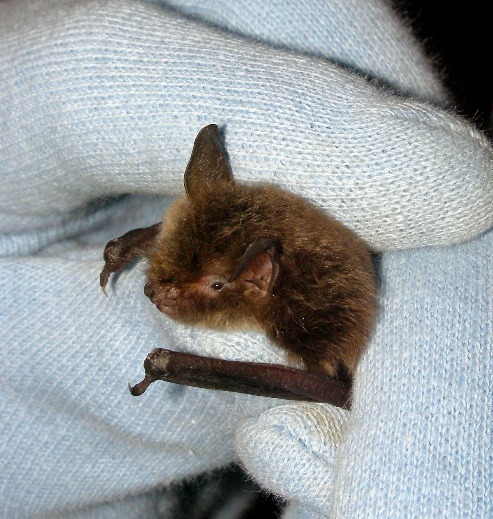
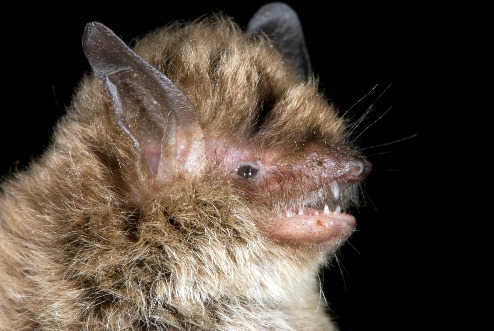
In June 2010, shortly after the announcement of the ‘new’ species, teams surveying woodland in west Kent as part of the BCT Bechstein’s Bat Survey were excited to find in one harp trap what looked like a whiskered bat with a suspiciously short forearm. Measurements were made and a series of photographs taken to record the pale slightly rounded snout, pink face, and feet smaller than the whiskered bat. These were sent to Professor Altringham who was pleased to confirm identification as Alcathoe, so, a new species for Kent too!
According to the Kent Bat Group, breeding has since been confirmed in two woodlands in West Kent.
