
Log in
Mammal of Kent

- Category: Rodentia (Mice, Voles etc)
- Identification:
Larger than the UK’s native red squirrel, the grey squirrel has mainly grey fur on its upper body with flecks of brown hairs and a white underside. The percentage of grey/brown hairs can vary in the population and both dark melanistic and white albino colour forms occur in small numbers in Kent. The sexes are similar in size and appearance. Unlike the red squirrel the grey squirrel has no ear tufts.
- Head and body length: 240 - 285 mm
- Tail length: 95 - 240 mm
- Weight: ♂ 440 - 650 g ♀ 400 - 720 g
- Distribution Map:
 Source: 2002–2012 Kent Mammal Atlas. These maps are provided for reference and do not include more recent recording updates

- Category: Rodentia (Mice, Voles etc)
- Identification:
A mature hazel dormouse has soft fine orange/yellow fur with a thick furry tail and large black eyes. The skin of the tail is thin and if gripped comes off, leaving the bones exposed. These quickly dry and drop off leaving the dormouse with a truncated tail. The hind feet can be rotated at the ankle, permitting the animal to hang head downwards.
- Head and body length: 60-90mm
- Tail length: 57-68mm
- Weight: 15-26g, increasing up to 43g before hibernation.
- Distribution Map:
 Source: 2002–2012 Kent Mammal Atlas. These maps are provided for reference and do not include more recent recording updates

- Category: Rodentia (Mice, Voles etc)
- Identification:
The bank vole has a chestnut brown coat, with breeding adults showing a redder tinge. The flanks are paler and the underside is whitish-cream. The muzzle is blunt and the ears are half hidden by fur. The tail is half the length of the body.
Often confused with the field vole, the bank vole has more prominent ears and a longer tail. The coat of the field vole is lighter and greyer without the reddish tinge.
Two melanistic bank voles were trapped during a small mammal survey that took place in West Blean woods in 2006. This is a rare colour variation within the species and is not often recorded.
- Head and body length: 79-117mm
- Tail length: 33-48mm
- Weight: 15-25g
- Distribution Map:
 Source: 2002–2012 Kent Mammal Atlas. These maps are provided for reference and do not include more recent recording updates

- Category: Rodentia (Mice, Voles etc)
- Identification:
The field vole has a greyish-brown coat and a creamy-grey underside with a greyer pelage in juveniles. Albinos and melanistic forms are rare but piebald animals with pale ear tufts are occasionally seen.
The field vole has small eyes and small ears that are almost totally hidden under its fur. It is similar in size to a bank vole, although males can be larger and are usually heavier than females. As a vole its nose is blunter than that of a mouse. The tail is only a third of its body length or less and it squeaks more readily when handled than the bank vole.
The field vole can be distinguished from the bank vole by the lack of chestnut or reddish colour in the coat, the shorter ears hidden under the fur and the shorter tail. Field voles can be distinguished from juvenile water voles by their smaller feet, shorter tail and paler coat colour.
Droppings and feeding signs may be confused with those of water voles as both species inhabit grassy river banks. However, signs of field voles are smaller.
- Head and body length: 95-120mm
- Tail length: 28-36mm (30% to 40% of head and body length)
- Weight: 20-45g
- Distribution Map:
 Source: 2002–2012 Kent Mammal Atlas. These maps are provided for reference and do not include more recent recording updates

- Category: Rodentia (Mice, Voles etc)
- Identification:
The water vole is the largest of the British vole species. Its coat is dark brown with a slightly lighter underside. The muzzle is blunt, the ears are hidden by a layer of fur and the tail has a covering of brown hair. The juvenile water vole has much larger feet in relation to its body size than the smaller field vole.
- Head and body length: 140-220mm
- Tail length: 95-140mm
- Weight: ♂ 180 - ~300g ♀ 160 - 210g
- Distribution Map:
 Source: 2002–2012 Kent Mammal Atlas. These maps are provided for reference and do not include more recent recording updates

- Category: Rodentia (Mice, Voles etc)
- Identification:
The harvest mouse is Europe’s smallest rodent. It has a blunter more vole-like face than most mice, with relatively large eyes that do not bulge and small rounded, well-furred ears. The body fur is orange-brown and the chin, throat and underparts are white. The grey-brown tail is proportionately long and is prehensile, enabling the mouse to use it to grasp plant stems whilst climbing.
- Head and body length: 50-70mm
- Tail length: 40-75mm
- Weight: 4-6g
- Distribution Map:
 Source: 2002–2012 Kent Mammal Atlas. These maps are provided for reference and do not include more recent recording updates

- Category: Rodentia (Mice, Voles etc)
- Identification:
The wood mouse has dark brown fur on the back with a greyish-white underside. There is a clear straight line where the two colours meet. It has a yellow chest spot which varies in shape and size but never meets with the brown fur of the back. Juveniles have a greyer pelage and paler chest spot than adults.
A mainly nocturnal species, it has protruding eyes and large ears. A tail as long as its body enables it to balance when climbing and jumping; the large hind feet assist with this.
Juveniles can be confused with the greyer house mouse but the wood mouse lacks the musty smell and has larger ears and feet. The house mouse does not have a clear line of demarcation between the dark dorsal and paler ventral fur colours.
Its fur colour and sparsely haired tail enable the wood mouse to be distinguished easily from the hazel dormouse, which has a bushy tail and a sandy-coloured coat.
- Head and body length: 81-103mm, Hindfoot (without claws): 19-23mm
- Tail length: 71-95mm
- Weight: 13-27g
- Distribution Map:
 Source: 2002–2012 Kent Mammal Atlas. These maps are provided for reference and do not include more recent recording updates

- Category: Rodentia (Mice, Voles etc)
- Identification:
The yellow-necked mouse is about one and a half times larger than the wood mouse and has a more orangey-brown coat on the back with a whiter underside. A complete yellow throat collar joins with the brown fur on the shoulders and is a distinguishing feature separating it from the wood mouse. In juveniles the collar is greyer in colour but still visible.
It is mainly nocturnal having noticeably larger ears and protruding eyes than those of the wood mouse. Its tail, which is longer than its body, and larger hind feet make it a more adept climber than the wood mouse.
- Head and body length: 95-120mm, Hindfoot (without claws): 22-26mm
- Tail length: 77-118mm
- Weight: 20-45g
- Distribution Map:
 Source: 2002–2012 Kent Mammal Atlas. These maps are provided for reference and do not include more recent recording updates

- Category: Rodentia (Mice, Voles etc)
- Identification:
The house mouse has a greyish-brown pelage with a slightly lighter underside. It is active during the day and at night, but is primarily nocturnal. It has a pointed nose, prominent ears and large eyes. The tail is bald and approximately the length of the body.
It may be confused with a juvenile wood mouse or yellow-necked mouse but has slightly smaller eyes and ears. It also lacks a clear divide between the dorsal and ventral colours and has a characteristic musty smell.
- Head and body length: 70-90mm
- Tail length: 70-95mm
- Weight: 15-20g
- Distribution Map:
 Source: 2002–2012 Kent Mammal Atlas. These maps are provided for reference and do not include more recent recording updates

- Category: Rodentia (Mice, Voles etc)
- Identification:
The common rat has greyish-brown fur and prominent eyes, a pointed muzzle and round ears. The bald tail is about as long as the head and body combined. It is larger than any mouse but can be confused with a water vole. However, there are physical differences between the two; the water vole has a blunt muzzle, hidden ears, a shorter hairier tail and a darker brown coat.
When swimming the water vole’s head, shoulders and rump remain above water, whereas the brown rat almost fully submerges itself with just its head and shoulders visible.
- Head and body length: 150-270mm
- Tail length: 105-240mm
- Weight: 200-600g
- Distribution Map:
 Source: 2002–2012 Kent Mammal Atlas. These maps are provided for reference and do not include more recent recording updates

- Category: Lagomorpha (Rabbits, Hares, etc.)
- Identification:
Rabbits have long ears, short forelegs and longer back legs. Most are grey-brown but there are variations towards beige/brown. Melanistic examples are seen frequently but albinos are rare. An important recognition feature is the white ‘powder puff’ underside of the tail, clearly seen as the rabbit runs away.
The rabbit is smaller than the brown hare with features that are less accentuated. The face is more rounded and less angular, with shorter ears without black tips.
- Head and body length: 400mm
- Weight: 1200-2000g
- Distribution Map:
 Source: 2002–2012 Kent Mammal Atlas. These maps are provided for reference and do not include more recent recording updates

- Category: Lagomorpha (Rabbits, Hares, etc.)
- Identification:
The brown hare is larger than the rabbit, with longer ears that have black tips. It has an overall colouration of russet-brown, a pale belly and a black stripe on the upper part of the tail. The sexes are alike although adult females tend to be larger than males.
Unlike a rabbit, a startled brown hare holds its tail down as it gallops away, showing a visible dorsal stripe. A startled rabbit holds its tail up as it runs, showing the white underside. The brown hare has longer legs that enable it to lope high off the ground with a leaping stride. The rabbit may jump from the ground in similar fashion to a hare but immediately drops into a ground-hugging run. Confusion between the grey coat of a rabbit and the russet-brown coat of a hare is unlikely and the iris of a rabbit is brown compared with yellow in the hare.
- Head and body length: 490-610mm
- Tail length: 40-100mm
- Weight: ♂ 2.23-4.10 kg ♀ 3.69-4.56 kg
- Distribution Map:
 Source: 2002–2012 Kent Mammal Atlas. These maps are provided for reference and do not include more recent recording updates

- Category: Insectivores (Shrews, Moles, etc.)
- Identification:
The hedgehog is unmistakable, being the UK’s only spined mammal. In general it is various shades of brown with slightly protruding black eyes and a fairly long snout. Variations in colour are seen but leucistic (blonde or white with black eyes), albinos and melanistic forms are very rarely observed.
The spines can be moved under muscular control, which enables the hedgehog to curl up when alarmed. Underneath, hedgehogs have a soft whitish belly/skirt which they can raise as they run off at around two to six miles per hour. They can swim, climb two metre structures when foraging, grunt and snuffle when mating and squeal when attacked. They have sensitive, set-back ears for detecting prey and an acute sense of smell but their eyesight is not good.
- Head and body length: 179-263mm
- Tail length: 17-35mm
- Weight: 800-1200g
- Distribution Map:
 Source: 2002–2012 Kent Mammal Atlas. These maps are provided for reference and do not include more recent recording updates

- Category: Insectivores (Shrews, Moles, etc.)
- Identification:
Moles have short black velvety fur, with spadelike forelimbs that have large claws facing towards the animal’s rear. They have very small eyes and a pink fleshy snout.
- Head and body length: 113-159mm
- Tail length: 25-40mm
- Weight: 72-128g
- Distribution Map:
 Source: 2002–2012 Kent Mammal Atlas. These maps are provided for reference and do not include more recent recording updates

- Category: Insectivores (Shrews, Moles, etc.)
- Identification:
The common shrew has a three-tone coat; a dark brown velvety back, paler brown flanks and a yellowish-grey underside. Its tail length is about 55% of its head and body length. Some individuals can show white patches on the ear tufts or tail tip. Tiny eyes offer poor eyesight so it relies on smell, sound and touch to detect prey using its narrow, pointed mobile snout and whiskers. Red iron deposits in the enamel of the tips of its needle-like teeth slow down wear that results from feeding on abrasive insect exoskeletons and soil-covered earthworms. Signs of wear of the red coating are seen in older animals.
The smaller pygmy shrew has a longer, thicker tail in proportion to its body size and length, paler body fur and no colour band along the flanks. The larger water shrew has black dorsal fur and hair fringes on the feet and tail.
- Head and body length: 48-80mm
- Tail length: 24-44mm
- Weight: 5-14g
- Distribution Map:
 Source: 2002–2012 Kent Mammal Atlas. These maps are provided for reference and do not include more recent recording updates

- Category: Insectivores (Shrews, Moles, etc.)
- Identification:
The pygmy shrew has a two-tone coat of greyish-brown on the back (paler than in the common shrew) and greyish-white on the underside. It is the smallest terrestrial mammal species in Britain. Its tail is long (70% of its body length) and thicker and hairier than that of the common shrew. With tiny eyes it relies on smell, sound and long whiskers to detect prey. As in the common shrew the needle-like teeth are red-tipped and it is able to decrease its body size in winter to reduce energy requirement.
In comparison the common shrew is larger with a darker three-tone coat and a shorter tail, although there can be some overlap in the weight of juvenile common shrews and large adult pygmy shrews.
- Head and body length: 40-60mm
- Tail length: 32-46mm
- Weight: 2.4-6.1g
- Distribution Map:
 Source: 2002–2012 Kent Mammal Atlas. These maps are provided for reference and do not include more recent recording updates

- Category: Insectivores (Shrews, Moles, etc.)
- Identification:
The water shrew is the largest of our three native shrew species. It has a two-tone coat of black on the back and white on the underside, sometimes with a yellow or brown ‘stain’. Melanistic forms with a dark underside regularly occur and white ear tufts and/or eyebrows are common. The fur, which is longer and denser than in terrestrial shrews, traps air, giving a silvery sheen to the body when swimming under water. The long tail has a keel of long, stiff, silvery hairs on the underside which increases the surface area and acts like a rudder during swimming. The toes are also fringed with hairs enabling all four feet to be used as paddles.
With tiny eyes, it relies on its long whiskers and mobile snout to detect prey under water, often searching through gravel and silt on the river bed. As in the common shrew the needle-like teeth are red-tipped and it is able to decrease its body size in winter to reduce energy requirement.
Common and pygmy shrews are smaller than water shrews with paler dorsal fur. They lack the fringes of hairs on the tail and feet.
- Head and body length: 67-96mm
- Tail length: 45-77mm
- Weight: 12-18g
- Distribution Map:
 Source: 2002–2012 Kent Mammal Atlas. These maps are provided for reference and do not include more recent recording updates

- Category: Chiroptera (Bats)
- Identification:
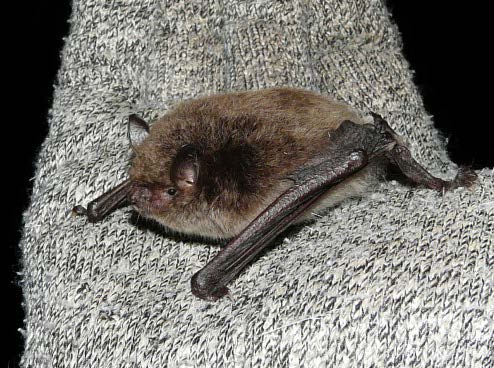
This species has dark grey or nut-brown shaggy fur on its back, buff/ greyish underneath, with a dark face and medium sized ears and a pointed tragus.
Whiskered bat has a fast fluttering flight with brief glides and occasional swoops.
Whiskered bat and Brandt’s bat are very similar and were only separated in 1970. Prior to 2010 they were recorded in hibernation as whiskered/Brandt’s. The recent addition of Alcathoe bat to the UK list makes the accuracy of many earlier records even less certain.
- Head and body length: 35-48mm
- Forearm length: 30-37mm
- Wingspan : 210-240mm
- Weight: 4-8g
- Distribution Map:
 Source: 2002–2012 Kent Mammal Atlas. These maps are provided for reference and do not include more recent recording updates
- Category: Chiroptera (Bats)
- Identification:
Brandt’s bat has dark grey or brown shaggy fur on its back, greyish underneath, with face and base of ears often pinkish. Young bats are darker but lighten after a few years.
It has rapid and skilful flight, often close to ground vegetation and up to the crown of trees.
Brandt's and whiskered bats are very similar and difficult to identify even in the hand. As with whiskered bats, the recent addition of Alcathoe to the UK list makes the accuracy of many earlier records even less certain.
- Head and body length: 38-50mm
- Forearm length: 31-39mm
- Wingspan : 210-240mm
- Weight: 4.5-9.5g
- Distribution Map:
 Source: 2002–2012 Kent Mammal Atlas. These maps are provided for reference and do not include more recent recording updates

- Category: Chiroptera (Bats)
- Identification:
5 Alcathoe bat is the smallest European Myotis species and has light brown fur which is slightly paler underneath. It is so similar in appearance to whiskered and Brandt’s bats that it was confused with these in the past. Its presence as a separate species in Europe was not recognised until 2001.
It has a short pale snout, with skin areas less pigmented, (especially the tragus which is noticeably pale towards the base), small feet and other subtle physical differences.
- Head and body length: 30.8-34.6mm
- Forearm length: 32.7-34.5mm
- Wingspan : 200mm
- Weight: 3.5-5.5g
- Distribution Map:
 Source: 2002–2012 Kent Mammal Atlas. These maps are provided for reference and do not include more recent recording updates

- Category: Chiroptera (Bats)
- Identification:
Daubenton’s bat has brown, fairly dense, woolly dorsal fur and pale buff ventral fur. The pinkish face is usually bare around the eyes.
After dark on warm summer evenings you may see Daubenton’s bats flying low over lakes and rivers. They take aquatic insects from close to the water, or even use their large hairy feet as a gaff or their tail membrane as a scoop to take insects from the surface.
- Head and body length: 45-55mm
- Forearm length: 31-39mm
- Wingspan : 210-240mm
- Weight: 7-12g
- Distribution Map:
 Source: 2002–2012 Kent Mammal Atlas. These maps are provided for reference and do not include more recent recording updates

- Category: Chiroptera (Bats)
- Identification:
Natterer’s bat has buff, shaggy fur on the back and is white underneath. It has long ears that are turned back at the tip, and a narrow pointed tragus which is longer than half the ear length. Its muzzle is long and bare. The old name of ‘red-armed bat’ is based on its limbs appearing pinkish.
It is broad-winged and slow-flying, both taking insects in flight and gleaning from vegetation without landing.
- Head and body length: 40-50mm
- Forearm length: 36-43mm
- Wingspan : 245-300mm
- Weight: 7-12g
- Distribution Map:
 Source: 2002–2012 Kent Mammal Atlas. These maps are provided for reference and do not include more recent recording updates

- Category: Chiroptera (Bats)
- Identification:
Bechstein’s bat has dorsal fur which is light to reddish-brown and clearly demarcated from the buff ventral fur.
It is a medium-sized bat with very large ears, well separated from each other, with a long straight tragus reaching to almost half the length of the ear. It has a long pink muzzle. These bats have slow fluttering flight; they can hover and are extremely agile, even in confined spaces.
- Head and body length: 43-53mm
- Forearm length: 38-47mm
- Wingspan : 250-300mm
- Weight: 7-13g
- Distribution Map:
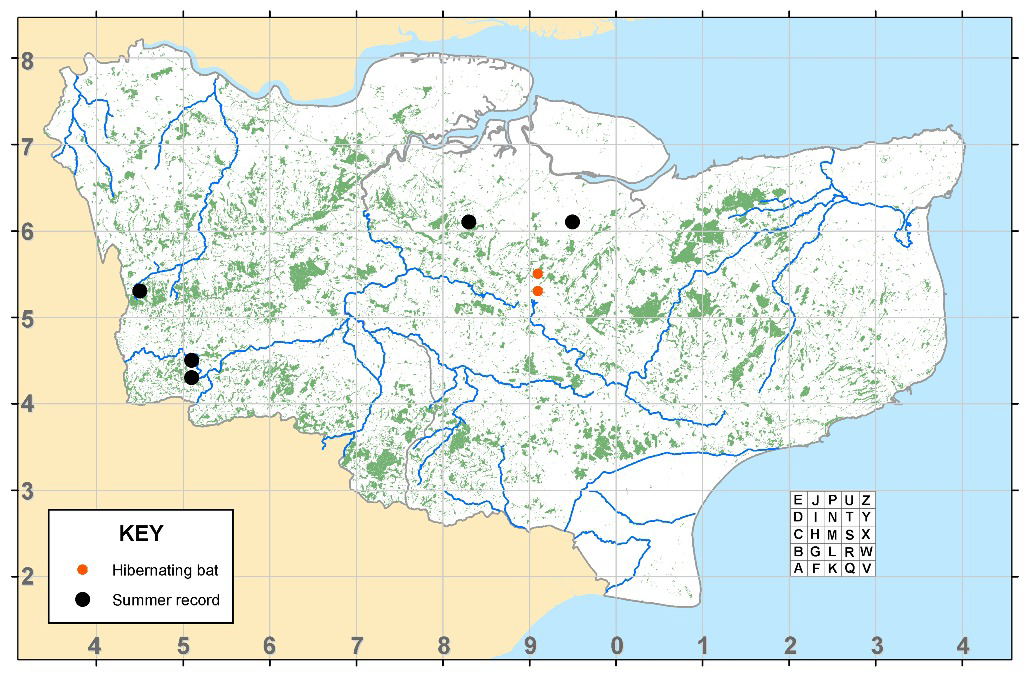 Source: 2002–2012 Kent Mammal Atlas. These maps are provided for reference and do not include more recent recording updates
- Category: Chiroptera (Bats)
- Identification:
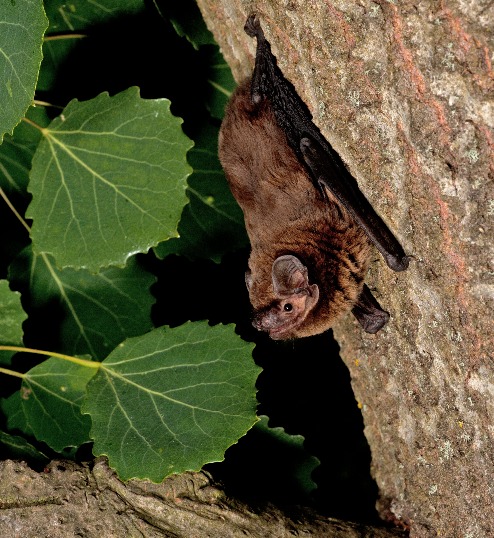
Leisler’s bat has long fur that is reddish-brown or golden-tipped and is darker at the base.
It is very similar in appearance to the noctule, though it is smaller and the fur is usually longer, shaggier and less glossy. The male often has a ruff of thicker fur. They appear early in the evening and usually fly high and fast in the open. Early books refer to it as the hairy-armed bat, due to a band of fur extending onto the wing membrane along the body and arms.
- Head and body length: 50-70mm
- Forearm length: 38-47mm
- Wingspan : 260-320mm
- Weight: 12-20g
- Distribution Map:
 Source: 2002–2012 Kent Mammal Atlas. These maps are provided for reference and do not include more recent recording updates

- Category: Chiroptera (Bats)
- Identification:
An adult noctule bat has sleek golden brown fur; juveniles are dull chocolate brown.
The noctule is one of our largest bats and has long narrow wings. The ears are short and rounded, with a mushroom-shaped tragus.
It emerges early to forage and can be seen well before dark flying high and fast, often in straight lines, with frequent steep stoops and glides to catch prey items.
- Head and body length: 37-48mm
- Forearm length: 48-58mm
- Wingspan : 320-400mm
- Weight: 18-40g
- Distribution Map:
 Source: 2002–2012 Kent Mammal Atlas. These maps are provided for reference and do not include more recent recording updates

- Category: Chiroptera (Bats)
- Identification:
The common pipistrelle is more or less a uniform medium to dark brown colour. The skin around the face and eyes is usually dark.
The common and soprano pipistrelles, our commonest bats, were only recognised as separate species in the late 1990s; prior to that all were recorded as Pipistrellus pipistrellus.
These two pipistrelle species can look very similar, the dark face of the common pipistrelle not always being obvious even in the hand, especially in juveniles. There is no ridge between the nostrils in common pipistrelle, and the pattern of the elastic fibres in the wing can also help to distinguish between the two. When using a bat detector it is usually, though not always, possible to separate them by the peak frequency of their echolocation calls.
- Head and body length: 35-45mm
- Forearm length: 30-35mm
- Wingspan : 200-235mm
- Weight: 3-8g
- Distribution Map:
 Source: 2002–2012 Kent Mammal Atlas. These maps are provided for reference and do not include more recent recording updates

- Category: Chiroptera (Bats)
- Identification:
The soprano pipistrelle has medium to dark brown fur, more or less uniform in colour. The skin of the face and around the eyes is usually pink in colour.
The common and soprano pipistrelles, our commonest bats, were only recognised as separate species in the late 1990s. Prior to that all were recorded as Pipistrellus pipistrellus. The soprano lacks the dark face of the common pipistrelle and has a slightly more rounded head. There is an obvious ridge between the nostrils (internarial ridge) in soprano pipistrelle, and the pattern of elastic fibres in the wing can also help to distinguish the two species. Adult soprano pipistrelles often, but not always, have a musky smell. When using a bat detector it is usually, though not always, possible to separate them by the peak frequency of their echolocation calls.
- Head and body length: 35-45mm
- Forearm length: 29-34mm
- Wingspan : 190-230mm
- Weight: 3-8g
- Distribution Map:
 Source: 2002–2012 Kent Mammal Atlas. These maps are provided for reference and do not include more recent recording updates

- Category: Chiroptera (Bats)
- Identification:
Nathusius’ pipistrelle has reddish-brown fur which is longer than that of common and soprano pipistrelle, occasionally showing frosted tips, and the belly fur is pale. Ears, membranes and face are usually very dark. It is bigger than the common and soprano pipistrelles and has broader wings, with slightly more shaggy fur. Its rapid flight is faster and less manoeuvrable, but its foraging style is similar.
- Head and body length: 46-55mm
- Forearm length: 32-37mm
- Wingspan : 228-250mm
- Weight: 6-10g
- Distribution Map:
 Source: 2002–2012 Kent Mammal Atlas. These maps are provided for reference and do not include more recent recording updates

- Category: Chiroptera (Bats)
- Identification:
The serotine has dark shaggy fur above and is paler underneath. Face, ears and membranes are black. This large bat looks more bird-like than other bats as it flies, with its broad wings and slow flight. It usually flies about four to 12 m above the ground, along woodland edges, over open pasture and around large trees close to the leaves. It is the only British bat that has a tail which extends beyond the edge of the tail membrane.
- Head and body length: 58-80mm
- Forearm length: 48-55mm
- Wingspan : 320-380mm
- Weight: 15-35g
- Distribution Map:
 Source: 2002–2012 Kent Mammal Atlas. These maps are provided for reference and do not include more recent recording updates

- Category: Chiroptera (Bats)
- Identification:
Adult brown long-eared bats have light brown fur and are pale underneath; juveniles are greyish with dark faces. These medium-sized bats emerge after dark, preferring not to fly in the open. Their flight is slow and fluttering, but short broad wings enable them to manoeuvre amongst branches, gleaning insects from the leaves as well as catching them in free flight. They frequently hover in front of moths before taking them, and occasionally land on the ground to tackle prey. They have very large eyes and sometimes use sight rather than echolocation to detect their prey. Their enormous ears are nearly as long as their body, but are often curled back or tucked under their wings when at rest.
- Head and body length: 37-52mm
- Forearm length: 34-42mm
- Wingspan : 230-285mm
- Weight: 6-12g
- Distribution Map:
 Source: 2002–2012 Kent Mammal Atlas. These maps are provided for reference and do not include more recent recording updates
- Category: Chiroptera (Bats)
- Identification:
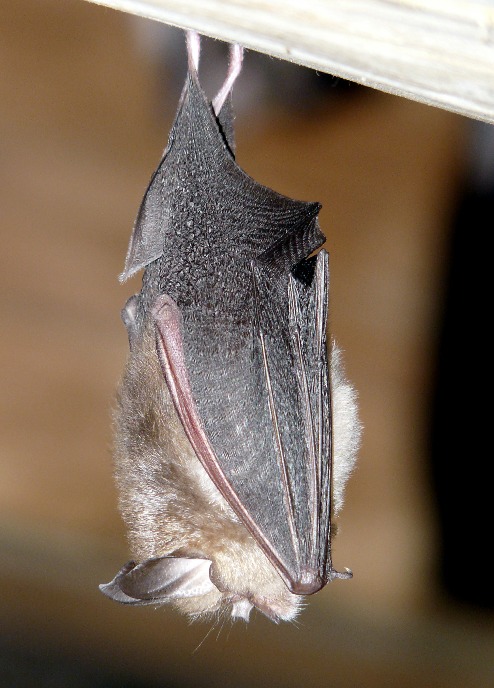
Adult lesser horseshoe bats are pinky buff-brown, juveniles are greyish. One of the smallest British species, the lesser horseshoe bat, wraps its wings around its body when at rest, and has a complex noseleaf related to its echolocation system (both features shared with the only other member of the horseshoe family in the UK, the greater horseshoe bat).
- Head and body length: 35-45mm
- Forearm length: 35-42mm
- Wingspan : 200-250mm
- Weight: 5-9g

- Category: Chiroptera (Bats)
- Identification:
The greater mouse-eared bat has sandy-coloured dorsal fur which contrasts strongly with the white fur underneath.
- Head and body length: 65-80mm
- Forearm length: 57-68mm
- Wingspan : 365-450mm
- Weight: 24-40g
- Category: Chiroptera (Bats)
- Identification:
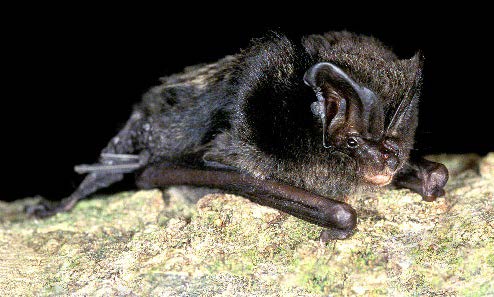
Barbastelle bats have dark fur showing lighter tips on the back, and skin surfaces of black or dark brown.
- Head and body length: 40-55mm
- Forearm length: 35-45mm
- Wingspan : 260-290mm
- Weight: 6-13g
- Category: Chiroptera (Bats)
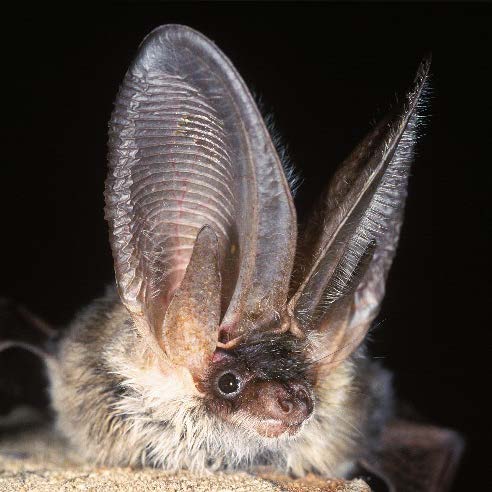
- Head and body length: 41-58mm, Thumb (mm): 5-6.5, Tragus (mm): 5.2-6.6
- Forearm length: 37-45mm
- Wingspan : 255-300mm
- Weight: 7-12g

- Category: Carnivora (Otter, Fox etc)
- Identification:
The coat of the fox is a mix of tawny-brown and grey with a long and often large bushy tail. It also has a long pointed snout and large pointed ears.
- Head and body length: 570-755mm
- Tail length: 335-470mm
- Weight: ♂ 5.5-8.2 kg ♀ 3.5-6.7 kg
- Distribution Map:
 Source: 2002–2012 Kent Mammal Atlas. These maps are provided for reference and do not include more recent recording updates

- Category: Carnivora (Otter, Fox etc)
- Identification:
9 A fully-grown badger has a grey-brown pelage overall, with darker fur to the limbs and occasionally the tail, a prominent black-and-white striped head, and usually white tips to the ears. The overall appearance is of a stocky animal, unmistakable to most people and not readily confused with any other native mammal. The hairs of the coat are usually banded, with a broad dark band between a short white tip and longer pale shank. The guard hairs are quite stiff and narrowly oval in cross-section. There is a degree of sexual dimorphism, with males (boars) being slightly larger and heavier than females (sows).
- Head and body length: 673-803mm
- Tail length: 114-190mm
- Weight: ♂ 9.1-16.7 kg ♀ 6.6-13.9 kg

- Category: Carnivora (Otter, Fox etc)
- Identification:
Otters have a broad muzzle and large flattened head, and a thick tapering tail. Their fur colour is medium to rich dark brown and may appear black when wet. Some lighter grey areas may occur around the throat and underparts and there are often white patches around the upper lip and chin.
- Head and body length: (average) ♂ 722mm ♀ 654mm
- Tail length: (average) ♂ 419mm ♀ 381mm
- Weight: (average) ♂ 8.75 kg ♀ 6.07 kg
- Distribution Map:
 Source: 2002–2012 Kent Mammal Atlas. These maps are provided for reference and do not include more recent recording updates

- Category: Carnivora (Otter, Fox etc)
- Identification:
Footprint:
Forefoot c. 20 x 22 mm, hindfoot c. 42 x 25 mm Bounding stride c. 300-500 mm between each group of four prints.Stoats are characterised by their long, cylindrical shape and short legs, allowing them to pursue their small mammal prey into its burrow. They are chestnut-brown to sandy-brown in colour with a pale, creamy belly, separated by a distinct straight line on the flanks. The tail has a distinctive black tip. Partially white (ermine) stoats, giving a mottled appearance, have been seen as far south as Wiltshire and Essex, but so far none have been confirmed in Kent. Males are about half as heavy again as females.
A stoat is generally larger than a weasel, with paler brown dorsal fur compared to the darker brown weasel. Stoats have creamy belly fur separated by a straight flank line; weasels have whiter belly fur and an irregular flank line. Weasels’ tails are shorter than stoats and have no black tip.
- Head and body length: ♂ 260-318mm ♀ 244-278mm
- Tail length: ♂ 67-199mm ♀ 69-100mm
- Weight: ♂ 252-471g ♀ 180-303g
- Distribution Map:
 Source: 2002–2012 Kent Mammal Atlas. These maps are provided for reference and do not include more recent recording updates

- Category: Carnivora (Otter, Fox etc)
- Identification:
Footprint:
Forefoot (mm): c. 13 x 10 hindfoot: c. 15 x 13 Bounding stride (mm): c. 200-300 between each set of four prints.The weasel is the smallest carnivore in Britain and is characterised by its long, cylindrical shape and short legs, allowing it to pursue small mammal prey into burrows. They have a chestnut-brown back and white belly demarcated by a wavy flank line (refer to the stoat account for other distinguishing features). Weasels in Britain do not turn white in winter.
- Head and body length: ♂ 195-248mm ♀ 175-194mm
- Tail length: ♂ 32-62mm ♀ 35-46mm
- Weight: ♂ 81-195g ♀ 48-107g
- Distribution Map:
 Source: 2002–2012 Kent Mammal Atlas. These maps are provided for reference and do not include more recent recording updates

- Category: Carnivora (Otter, Fox etc)
- Identification:
Footprint size is very variable:
Forefoot (mm): 25-40 x 30-35
Stride when bounding (mm): c. 400-600 between each set of four prints.The polecat-ferret and feral ferret are both ferrets and can be distinguished from a true polecat if one or more of the following features are present:
- body fur is paler than the wild polecat type (taking account of seasonal pelage variations)
- dark fur on the face does not reach the naked skin surface around the nostrils
- pale cheek patches and frontal band are often very extensive and contrast poorly with the darker facial mask, which may be absent, taking into account seasonal variations
- pale throat patch is 50 mm or more in length
- polecat-ferret has one or more pale furred paws
- scattered white guard hairs occur over the body of polecat-ferret, especially on hindquarters and tail
The feral ferret and polecat-ferret are similar in size and proportions to the polecat. The feral ferret skull also has a distinctive ‘waist’ between the eye sockets that is not present in a pure polecat.
The polecat has a long sinuous body and short legs. It has dark brown guard hairs which overlie pale underfur, giving it a two-tone appearance particularly in winter, when the whole animal becomes lighter in colour. Its most distinctive feature is the ‘banditmask’ pattern of dark and light facial markings. This is thought to be aposematic colouration, warning other animals of the pungent smell it will release from its paired anal glands as a defence.
- Head and body length: ♂ 390-430mm ♀ 305-366mm
- Tail length: ♂ 123-156mm ♀ 101-135mm
- Weight: ♂ 1288-1789g ♀ 496-972g
- Distribution Map:
 Source: 2002–2012 Kent Mammal Atlas. These maps are provided for reference and do not include more recent recording updates

- Category: Carnivora (Otter, Fox etc)
- Identification:
The American mink is a non-native medium-sized semi-aquatic mustelid, with dark brown to almost black fur and a white chin patch. On some individuals the white markings extend further down the throat and underside. Mink are sometimes confused with otter but are very much smaller with a short bushier tail, roughly half the body length, as opposed to an otter’s large tail with a flat broad base. Mink have a more pointed muzzle reminiscent of a ferret, whereas otter muzzles are broader with a large flattened head reminiscent of a common seal. Mink swim with their head and body high out of the water, whereas an otter will swim with only its head and part of the tail visible. Mink may also be confused with polecat-ferret in locations where they co-exist, as they are of a similar size and can occupy the same habitat. Mink are marginally smaller and have a dark face with a white chin spot, unlike polecat-ferrets which have a white snout with a white band above the eyes.
- Head and body length: ♂ 330-450mm ♀ 320-360mm
- Weight: ♂ 850-1805g ♀ 450-810g
- Distribution Map:
 Source: 2002–2012 Kent Mammal Atlas. These maps are provided for reference and do not include more recent recording updates
- Category: Pinnipedia (Seals)
- Identification:
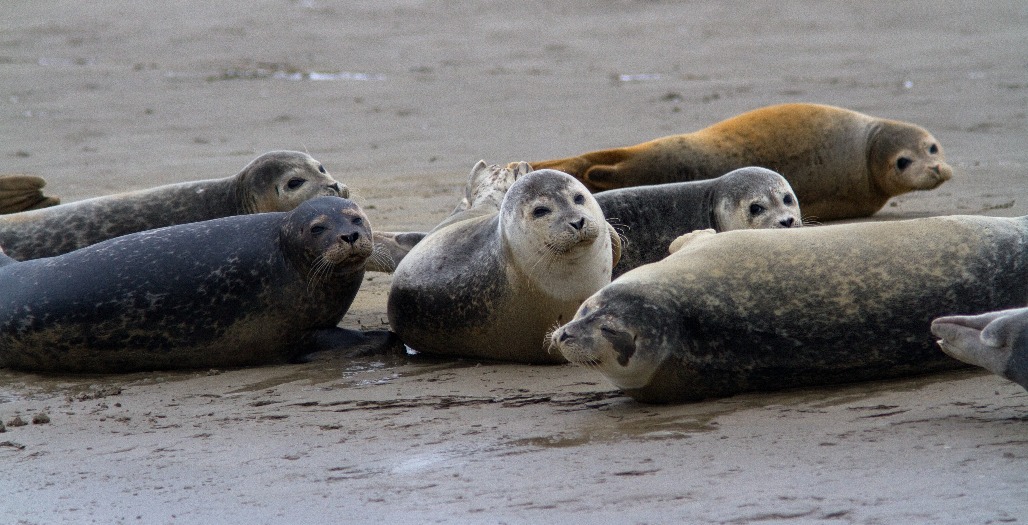
The common seal can be identified by its snub nose and rounded, dog-like head shape, which contrasts to the elongated Roman nose of the grey seal. When observed at close range the common seal has a ‘V’ shaped nostrils. Their pelage has a fine, freckly spot pattern; however, this can be absent during their annual moult when their pelage becomes dull beige or brown in appearance.
- Head and body length: ♂ 138-158cm ♀ 125-150cm
- Weight: ♂ 68-125kg ♀ 50-98kg
- Distribution Map:
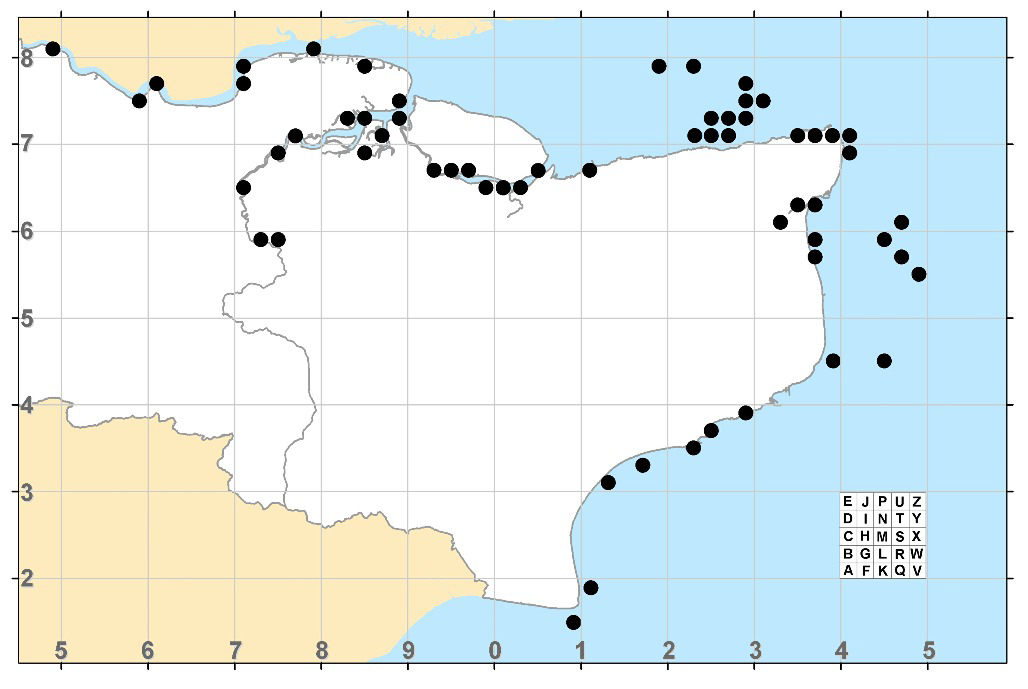 Source: 2002–2012 Kent Mammal Atlas. These maps are provided for reference and do not include more recent recording updates
- Category: Pinnipedia (Seals)
- Identification:
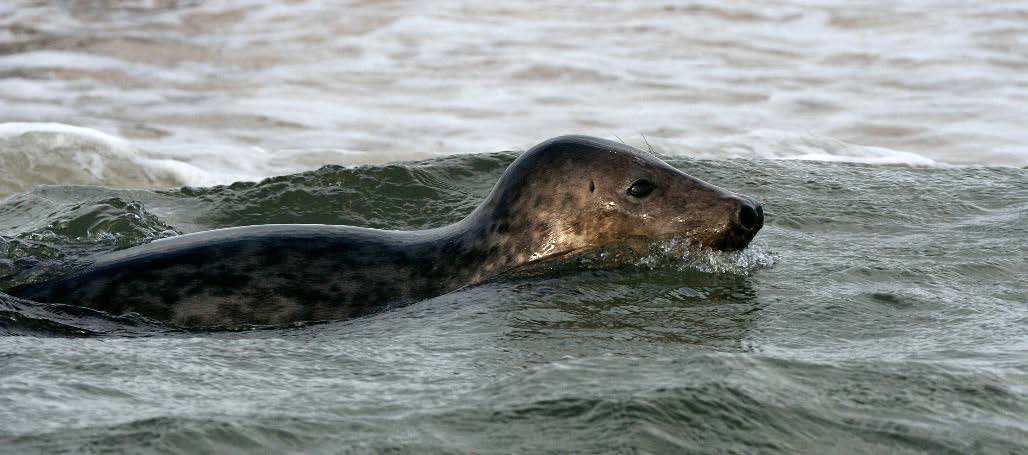
Grey seals are large, sexually dimorphic phocid seals (true or ‘earless’ seals) with males weighing far more than females. Grey seals have an elongated muzzle with a ‘Roman’ nose and parallel nostrils. Their coat colouration can vary greatly, but in general grey seals have a ‘blotchy’ pattern to their pelage and sometimes show a series of dark spots around the head and shoulders against a lighter-coloured background. Males are often a dark grey or uniformly brown.
- Head and body length: ♂ 195-230cm ♀ 143-197cm
- Weight: ♂ 170-440kg ♀ 131-251kg
- Distribution Map:
 Source: 2002–2012 Kent Mammal Atlas. These maps are provided for reference and do not include more recent recording updates

- Category: Ungulates (Deer, boar etc)
- Identification:
The wild boar is one of Britain’s largest mammals and has a formidable appearance. From a large head and muscular neck and shoulders, the body slopes down the back to the rump and a long-haired tail. The snout is long and narrow, ending in a cartilaginous disc; the ears are small and always erect. From the age of two, adult males have well-developed tusks that grow continuously. The lower tusks have a sharp cutting edge and are repeatedly sharpened by rubbing against the upper tusks, which are hollow and act as a permanent whetstone. Females (sows) are similar but have less heavy front quarters and no tusks. The coat in both sexes is shaggy and brindled, the guard hairs having lighter coloured tips. There is an underlying thick woolly pelage of light brown hair, and a mane of longer bristles running the length of the spine. Coat colour ranges from light fawn to black and adults moult annually in June to August.
- Head and body length: ♂ 150cm ♀ 140cm
- Shoulder height : ♂ 70-90cm
- Weight: ♂ up to 150kg ♀ up to 95kg
- Distribution Map:
 Source: 2002–2012 Kent Mammal Atlas. These maps are provided for reference and do not include more recent recording updates

- Category: Ungulates (Deer, boar etc)
- Identification:
16 A fully-grown muntjac has a red-brown summer pelage with a buff-coloured underside and variable amounts of white on the chin and inside of the thighs. The tail is a rich red or chestnut colour with white on the underside. The winter coat is much greyer and almost black on the underside, and males at maturity have a near V-shaped black stripe up the pedicles (antler attachment points) and frontal region of the head.
Males (bucks) acquire simple unbranched antlers at between five and 20 weeks old and these continue to develop as the buck ages, eventually forming small brow tines. Bucks shed and regrow their antlers each year. Muntjac have a distinctive dog-like barking call and lift their large tail when running away, revealing a white underside. They are usually solitary and may live for 14 years in the wild.
Muntjac is the smallest British deer species, and cannot easily be confused with other species except the Chinese water deer which has not occurred in Kent to date.
- Head and body length: 77-91cm
- Shoulder height : 45-52cm
- Tail length: 13-18cm
- Weight: ♂ 12.3-17kg ♀ 10-16kg
- Distribution Map:
 Source: 2002–2012 Kent Mammal Atlas. These maps are provided for reference and do not include more recent recording updates

- Category: Ungulates (Deer, boar etc)
- Identification:
Sika along with red deer are the largest deer in the UK and are often confused with each other, since they are very similar in size and colouration. Especially in summer, red deer have no spots on their backs, which is unlike all other British deer including sika. Both red and sika deer have branched antlers; sika deer usually have a maximum of eight points and red deer up to 16 points. In red deer the angle between the brow tine (first point) and the main beam (main shaft of the antler) is always more than 90º. The tail of a sika deer is white with a dark stripe, compared with plain yellow-brown in the red deer.
- Head and body length: 1.4-1.8m
- Shoulder height : 50-120cm
- Tail length: 14-21cm
- Weight: ♂ 40-63 kg ♀ 31-44 kg
- Distribution Map:
 Source: 2002–2012 Kent Mammal Atlas. These maps are provided for reference and do not include more recent recording updates

- Category: Ungulates (Deer, boar etc)
- Identification:
Adult fallow deer usually exhibit one of four main colour variations - common, menil, black and white. The common colour is a tan brown with spots on the flanks which fade in winter, and a white rump with a diagnostic black stripe down the tail and the sides of the rump. Menil is paler with spots all year round, but no black rump outline. Black forms are almost completely black, with no white. White forms are not albino but white or sandy-coloured.
Males (bucks) develop simple unbranched antlers at about six months of age, but size and complexity of antlers varies with age, genetics and overall health. This is the only British species of deer to have palmate antlers.
- Head and body length: ♂ 155-179cm ♀ 138-157cm
- Shoulder height : ♂ 840-940mm ♀ 730-910mm
- Tail length: ♂ 180-240mm ♀ 140-210mm
- Distribution Map:
 Source: 2002–2012 Kent Mammal Atlas. These maps are provided for reference and do not include more recent recording updates

- Category: Ungulates (Deer, boar etc)
- Identification:
A fully-grown roe deer has a uniform red/brown summer pelage with a distinctive whitish, inverted heart-shaped patch on the rump, which is more obvious in females in winter. The rump patch in males is cream rather than white and more kidneyshaped. Roe deer (bucks) have relatively short antlers which are cast in October to December each year. Males (bucks) develop their first simple button antlers at about 12 to 16 weeks of age, with the first true antlers subsequently forming as simple spikes.
- Head and body length: ♂ 90-138cm ♀ 85-138.5cm
- Distribution Map:
 Source: 2002–2012 Kent Mammal Atlas. These maps are provided for reference and do not include more recent recording updates

- Category: Cetacea (Whales)
- Identification:
The harbour porpoise is the smallest cetacean to occur around the coast of Kent. It has a robust body with a small rounded head and no beak. Its small triangular dorsal fin is centrally placed. The body colour is dark grey merging to a lighter grey on the sides, with the underside being white. Calves and juveniles often have brownish backs. They have a quick surface-rolling action and when alarmed or moving at speed they can produce a distinctive splash that is similar to a ‘rooster tail’ in shape.
It is generally unobtrusive but breaching behaviour, where the whole body is launched from the water has been observed at Dungeness. In Kent waters, the only species that might be confused with the harbour porpoise is the bottlenose dolphin. It also has a greyish colour and central dorsal fin, but this fin and the whole animal is much larger with a pronounced beak. It also behaves more extrovertly.
- Head and body length: ♂ 145-163cm ♀ 160-189cm
- Weight: ♂ 50-54 kg ♀ 50-81 kg
- Distribution Map:
 Source: 2002–2012 Kent Mammal Atlas. These maps are provided for reference and do not include more recent recording updates
