
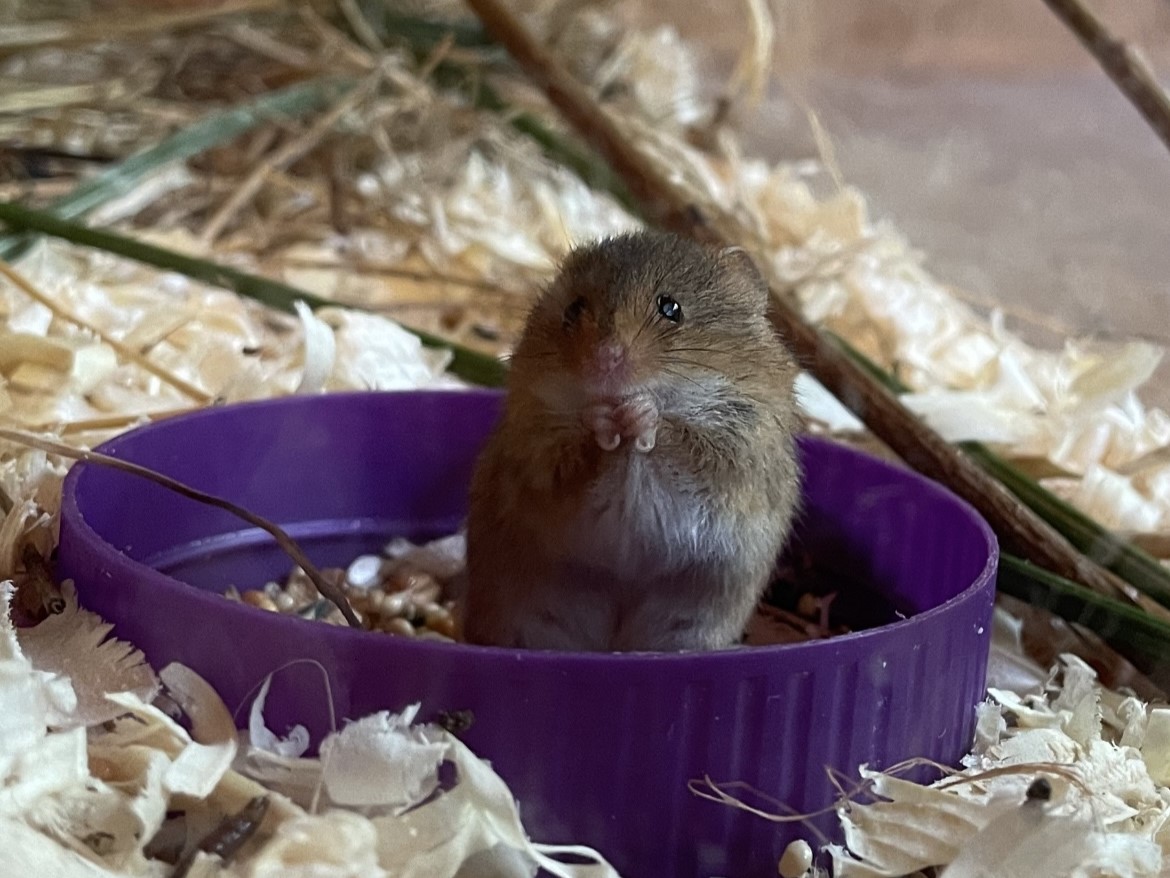


Field signs
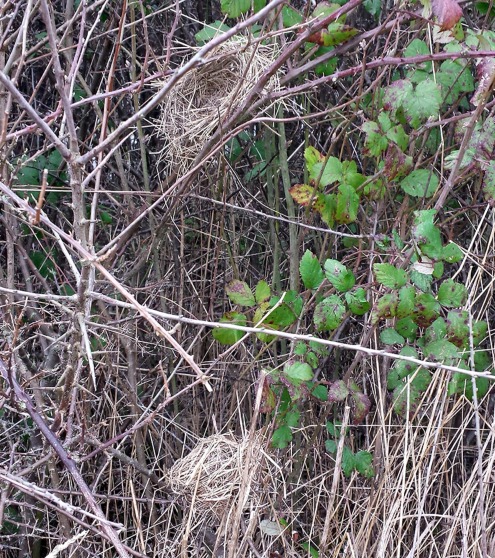
Small nests of woven grass leaves are sited above ground level usually at a height of 30 to 60 cm. Newly constructed nests are difficult to find because they are green, being built from living grass leaves. By early winter the grass leaves are brown and withered making the nests easier to locate.
Habits
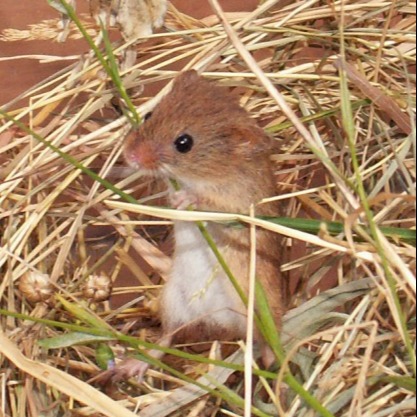
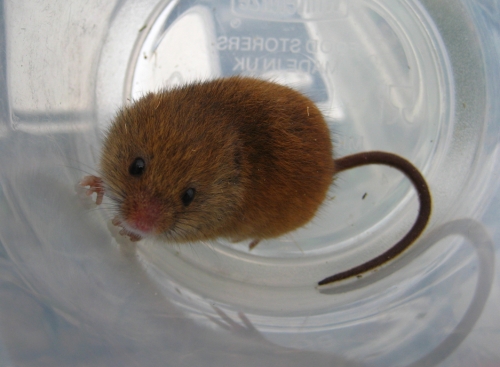
The small size and light-weight, prehensile tail, and large opposable toe of the harvest mouse are all adaptations for life in the ‘stalk zone’of long grasses and reeds. This is a habitat niche shared only with the pygmy shrew and juveniles of some mice and voles, for a brief period before they become too heavy. Here the mouse can find a wide variety of small seeds, green shoots and invertebrates to feed on through most of the year. In the winter it becomes more terrestrial and utilises the tunnels and runs of other small mammals such as the bank vole.
Nests occur in a wide variety of grassy habitats; road verges bordering arable fields, arable field headlands, margins of lakes, reservoirs, rivers, ditches and streams. Hedgerows are also used, particularly young grassy ones that have a diverse floral base.
Harvest mice are extremely difficult to observe in the wild. They are very sensitive to disturbance, fast moving and being so small, easily concealed. They are predominantly crepuscular, although during summer months they exhibit more diurnal behaviour to compensate for shorter nights.
Reproduction and life cycle
Nests may vary in height above the ground from a few centimetres in grass and sedge tussocks in winter to over a metre in reed beds at other times of the year. Breeding nests are between eight and 11 cm in diameter; winter nests and nests of individuals will be smaller. New grass growth rarely reaches sufficient height or hardens off so that it may safely support a nest before late May or early June. Breeding activity peaks in August and September and is not uncommon in October. In favourable years it may even continue until December.
After a gestation of 18 to 21 days, an average litter of four to five young is born. After giving birth the female then only visits the nest at intervals to feed and clean the young, closing up the exit hole behind her when she leaves.
Prior to full weaning the young are introduced to solids via regurgitation feeding. Harvest mice are the only UK mammal outside the canid family known to do this. At 10 days the young mice may venture outside the nest and at 15 to 16 days become completely independent. Maturity is reached at 45 days when they are ready to breed.
Distribution, status and conservation
The historically strong association of harvest mice with agricultural fields is reducing, though their nests can still be found at the field margins. Wheat varieties are no longer so tall or leafy as they were and no longer easily support nests. In addition weeds are ruthlessly eradicated from the crop, reducing diversity and structure. The practice of flailing hedges and mowing verges has taken place earlier and earlier in recent years and field headlands, field-facing hedgerows and ditches are scoured in August. Mechanical harvesting of crops may have contributed to the harvest mouse’s decline in cereal fields. At worst it destroys late breeding nests and their contents.
The clustered distribution pattern for parts of Kent results from surveys targeted specifically at harvest mice and represents a bias in recorder effort. Incidental records make up less than one third of the county total; however, they do show that the harvest mouse is widespread.
The harvest mouse is designated as a species of principal importance under the NERC Act. It has an IUCN conservation status of Near Threatened in Great Britain.
