
Mammals
caption and copyright hereLog in
Chiroptera (Bats)

- Category: Chiroptera (Bats)
- Identification:
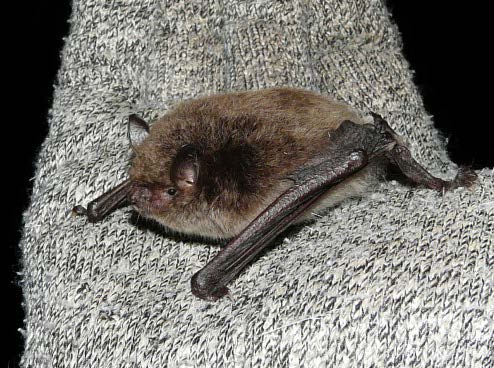
This species has dark grey or nut-brown shaggy fur on its back, buff/ greyish underneath, with a dark face and medium sized ears and a pointed tragus.
Whiskered bat has a fast fluttering flight with brief glides and occasional swoops.
Whiskered bat and Brandt’s bat are very similar and were only separated in 1970. Prior to 2010 they were recorded in hibernation as whiskered/Brandt’s. The recent addition of Alcathoe bat to the UK list makes the accuracy of many earlier records even less certain.
- Head and body length: 35-48mm
- Forearm length: 30-37mm
- Wingspan : 210-240mm
- Weight: 4-8g
- Distribution Map:
 Source: 2002–2012 Kent Mammal Atlas. These maps are provided for reference and do not include more recent recording updates
- Category: Chiroptera (Bats)
- Identification:
Brandt’s bat has dark grey or brown shaggy fur on its back, greyish underneath, with face and base of ears often pinkish. Young bats are darker but lighten after a few years.
It has rapid and skilful flight, often close to ground vegetation and up to the crown of trees.
Brandt's and whiskered bats are very similar and difficult to identify even in the hand. As with whiskered bats, the recent addition of Alcathoe to the UK list makes the accuracy of many earlier records even less certain.
- Head and body length: 38-50mm
- Forearm length: 31-39mm
- Wingspan : 210-240mm
- Weight: 4.5-9.5g
- Distribution Map:
 Source: 2002–2012 Kent Mammal Atlas. These maps are provided for reference and do not include more recent recording updates

- Category: Chiroptera (Bats)
- Identification:
5 Alcathoe bat is the smallest European Myotis species and has light brown fur which is slightly paler underneath. It is so similar in appearance to whiskered and Brandt’s bats that it was confused with these in the past. Its presence as a separate species in Europe was not recognised until 2001.
It has a short pale snout, with skin areas less pigmented, (especially the tragus which is noticeably pale towards the base), small feet and other subtle physical differences.
- Head and body length: 30.8-34.6mm
- Forearm length: 32.7-34.5mm
- Wingspan : 200mm
- Weight: 3.5-5.5g
- Distribution Map:
 Source: 2002–2012 Kent Mammal Atlas. These maps are provided for reference and do not include more recent recording updates

- Category: Chiroptera (Bats)
- Identification:
Daubenton’s bat has brown, fairly dense, woolly dorsal fur and pale buff ventral fur. The pinkish face is usually bare around the eyes.
After dark on warm summer evenings you may see Daubenton’s bats flying low over lakes and rivers. They take aquatic insects from close to the water, or even use their large hairy feet as a gaff or their tail membrane as a scoop to take insects from the surface.
- Head and body length: 45-55mm
- Forearm length: 31-39mm
- Wingspan : 210-240mm
- Weight: 7-12g
- Distribution Map:
 Source: 2002–2012 Kent Mammal Atlas. These maps are provided for reference and do not include more recent recording updates

- Category: Chiroptera (Bats)
- Identification:
Natterer’s bat has buff, shaggy fur on the back and is white underneath. It has long ears that are turned back at the tip, and a narrow pointed tragus which is longer than half the ear length. Its muzzle is long and bare. The old name of ‘red-armed bat’ is based on its limbs appearing pinkish.
It is broad-winged and slow-flying, both taking insects in flight and gleaning from vegetation without landing.
- Head and body length: 40-50mm
- Forearm length: 36-43mm
- Wingspan : 245-300mm
- Weight: 7-12g
- Distribution Map:
 Source: 2002–2012 Kent Mammal Atlas. These maps are provided for reference and do not include more recent recording updates

- Category: Chiroptera (Bats)
- Identification:
Bechstein’s bat has dorsal fur which is light to reddish-brown and clearly demarcated from the buff ventral fur.
It is a medium-sized bat with very large ears, well separated from each other, with a long straight tragus reaching to almost half the length of the ear. It has a long pink muzzle. These bats have slow fluttering flight; they can hover and are extremely agile, even in confined spaces.
- Head and body length: 43-53mm
- Forearm length: 38-47mm
- Wingspan : 250-300mm
- Weight: 7-13g
- Distribution Map:
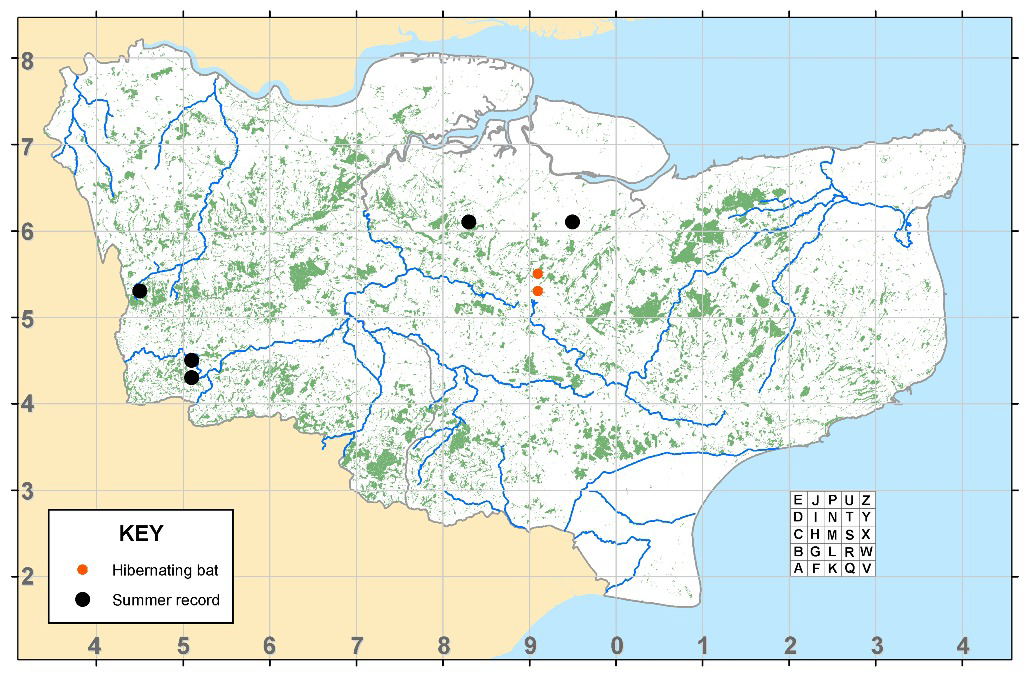 Source: 2002–2012 Kent Mammal Atlas. These maps are provided for reference and do not include more recent recording updates
- Category: Chiroptera (Bats)
- Identification:
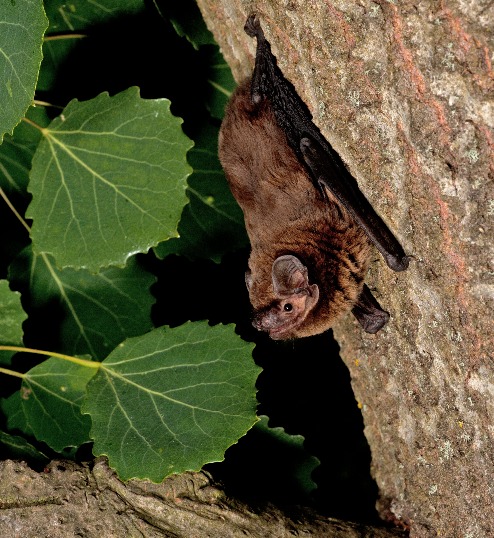
Leisler’s bat has long fur that is reddish-brown or golden-tipped and is darker at the base.
It is very similar in appearance to the noctule, though it is smaller and the fur is usually longer, shaggier and less glossy. The male often has a ruff of thicker fur. They appear early in the evening and usually fly high and fast in the open. Early books refer to it as the hairy-armed bat, due to a band of fur extending onto the wing membrane along the body and arms.
- Head and body length: 50-70mm
- Forearm length: 38-47mm
- Wingspan : 260-320mm
- Weight: 12-20g
- Distribution Map:
 Source: 2002–2012 Kent Mammal Atlas. These maps are provided for reference and do not include more recent recording updates

- Category: Chiroptera (Bats)
- Identification:
An adult noctule bat has sleek golden brown fur; juveniles are dull chocolate brown.
The noctule is one of our largest bats and has long narrow wings. The ears are short and rounded, with a mushroom-shaped tragus.
It emerges early to forage and can be seen well before dark flying high and fast, often in straight lines, with frequent steep stoops and glides to catch prey items.
- Head and body length: 37-48mm
- Forearm length: 48-58mm
- Wingspan : 320-400mm
- Weight: 18-40g
- Distribution Map:
 Source: 2002–2012 Kent Mammal Atlas. These maps are provided for reference and do not include more recent recording updates

- Category: Chiroptera (Bats)
- Identification:
The common pipistrelle is more or less a uniform medium to dark brown colour. The skin around the face and eyes is usually dark.
The common and soprano pipistrelles, our commonest bats, were only recognised as separate species in the late 1990s; prior to that all were recorded as Pipistrellus pipistrellus.
These two pipistrelle species can look very similar, the dark face of the common pipistrelle not always being obvious even in the hand, especially in juveniles. There is no ridge between the nostrils in common pipistrelle, and the pattern of the elastic fibres in the wing can also help to distinguish between the two. When using a bat detector it is usually, though not always, possible to separate them by the peak frequency of their echolocation calls.
- Head and body length: 35-45mm
- Forearm length: 30-35mm
- Wingspan : 200-235mm
- Weight: 3-8g
- Distribution Map:
 Source: 2002–2012 Kent Mammal Atlas. These maps are provided for reference and do not include more recent recording updates

- Category: Chiroptera (Bats)
- Identification:
The soprano pipistrelle has medium to dark brown fur, more or less uniform in colour. The skin of the face and around the eyes is usually pink in colour.
The common and soprano pipistrelles, our commonest bats, were only recognised as separate species in the late 1990s. Prior to that all were recorded as Pipistrellus pipistrellus. The soprano lacks the dark face of the common pipistrelle and has a slightly more rounded head. There is an obvious ridge between the nostrils (internarial ridge) in soprano pipistrelle, and the pattern of elastic fibres in the wing can also help to distinguish the two species. Adult soprano pipistrelles often, but not always, have a musky smell. When using a bat detector it is usually, though not always, possible to separate them by the peak frequency of their echolocation calls.
- Head and body length: 35-45mm
- Forearm length: 29-34mm
- Wingspan : 190-230mm
- Weight: 3-8g
- Distribution Map:
 Source: 2002–2012 Kent Mammal Atlas. These maps are provided for reference and do not include more recent recording updates

- Category: Chiroptera (Bats)
- Identification:
Nathusius’ pipistrelle has reddish-brown fur which is longer than that of common and soprano pipistrelle, occasionally showing frosted tips, and the belly fur is pale. Ears, membranes and face are usually very dark. It is bigger than the common and soprano pipistrelles and has broader wings, with slightly more shaggy fur. Its rapid flight is faster and less manoeuvrable, but its foraging style is similar.
- Head and body length: 46-55mm
- Forearm length: 32-37mm
- Wingspan : 228-250mm
- Weight: 6-10g
- Distribution Map:
 Source: 2002–2012 Kent Mammal Atlas. These maps are provided for reference and do not include more recent recording updates

- Category: Chiroptera (Bats)
- Identification:
The serotine has dark shaggy fur above and is paler underneath. Face, ears and membranes are black. This large bat looks more bird-like than other bats as it flies, with its broad wings and slow flight. It usually flies about four to 12 m above the ground, along woodland edges, over open pasture and around large trees close to the leaves. It is the only British bat that has a tail which extends beyond the edge of the tail membrane.
- Head and body length: 58-80mm
- Forearm length: 48-55mm
- Wingspan : 320-380mm
- Weight: 15-35g
- Distribution Map:
 Source: 2002–2012 Kent Mammal Atlas. These maps are provided for reference and do not include more recent recording updates

- Category: Chiroptera (Bats)
- Identification:
Adult brown long-eared bats have light brown fur and are pale underneath; juveniles are greyish with dark faces. These medium-sized bats emerge after dark, preferring not to fly in the open. Their flight is slow and fluttering, but short broad wings enable them to manoeuvre amongst branches, gleaning insects from the leaves as well as catching them in free flight. They frequently hover in front of moths before taking them, and occasionally land on the ground to tackle prey. They have very large eyes and sometimes use sight rather than echolocation to detect their prey. Their enormous ears are nearly as long as their body, but are often curled back or tucked under their wings when at rest.
- Head and body length: 37-52mm
- Forearm length: 34-42mm
- Wingspan : 230-285mm
- Weight: 6-12g
- Distribution Map:
 Source: 2002–2012 Kent Mammal Atlas. These maps are provided for reference and do not include more recent recording updates
- Category: Chiroptera (Bats)
- Identification:
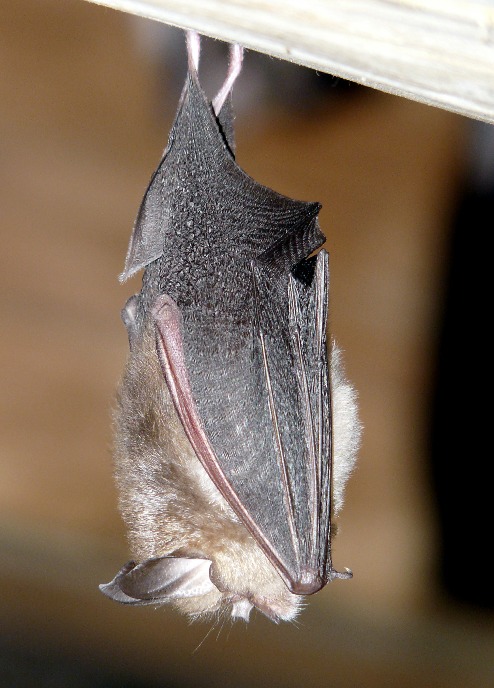
Adult lesser horseshoe bats are pinky buff-brown, juveniles are greyish. One of the smallest British species, the lesser horseshoe bat, wraps its wings around its body when at rest, and has a complex noseleaf related to its echolocation system (both features shared with the only other member of the horseshoe family in the UK, the greater horseshoe bat).
- Head and body length: 35-45mm
- Forearm length: 35-42mm
- Wingspan : 200-250mm
- Weight: 5-9g

- Category: Chiroptera (Bats)
- Identification:
The greater mouse-eared bat has sandy-coloured dorsal fur which contrasts strongly with the white fur underneath.
- Head and body length: 65-80mm
- Forearm length: 57-68mm
- Wingspan : 365-450mm
- Weight: 24-40g
- Category: Chiroptera (Bats)
- Identification:
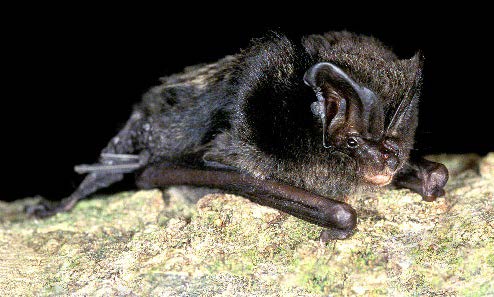
Barbastelle bats have dark fur showing lighter tips on the back, and skin surfaces of black or dark brown.
- Head and body length: 40-55mm
- Forearm length: 35-45mm
- Wingspan : 260-290mm
- Weight: 6-13g
- Category: Chiroptera (Bats)
- Head and body length: 41-58mm, Thumb (mm): 5-6.5, Tragus (mm): 5.2-6.6
- Forearm length: 37-45mm
- Wingspan : 255-300mm
- Weight: 7-12g

Raising awareness of the County's mammals, promoting study and recording, mammal courses and events.