
Echolocation
Echolocation is very quiet, with the regular and rapid clicks typical of Myotis bats. The frequency of most power is 50 kHz, but the call has a broad frequency range, and caution is needed when using heterodyne detectors to identify Myotis bat species.
Habits
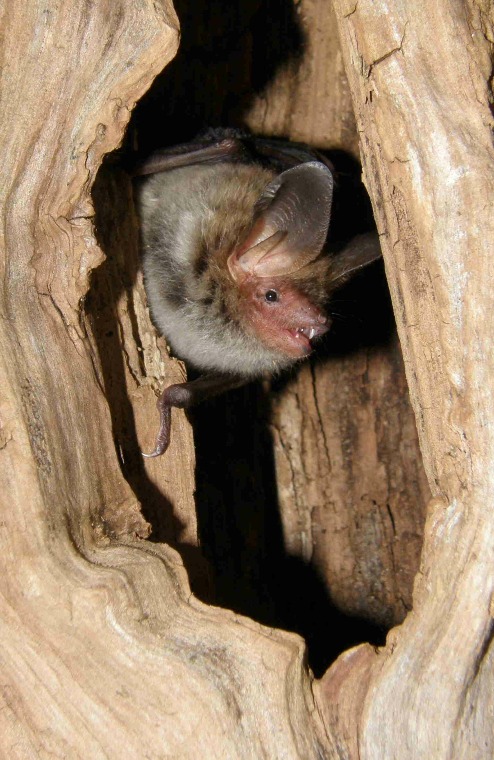
Bechstein’s bat is a rare bat in the U.K, found almost exclusively in deciduous woodland habitat, preferably with a well-developed understorey. It forages in enclosed vegetation from high in the canopy to low on the ground.
Prey may include not only flies and moths caught in flight, but also non-flying insect larvae and spiders gleaned from tree trunks or from the ground.
Summer roosts are usually in tree crevices, also in bat boxes but only very rarely in buildings. In winter, preferred hibernation roosts include woodpecker holes, old oak trees and ash.
Reproduction and life cycle
Maternity colonies consist of related females, and are often spread across several roosts, subdividing and recombining again, and changing roost every few days.
From the end of August the nursery colonies disperse and swarming occurs at hibernation sites, as with other Myotis species. The maximum age recorded so far is 23 years.
Distribution, status and conservation
This is one of the UK’s rarest bats, restricted mainly to the southern part of England. The destruction of ancient mature forests along with intensive woodland management practices such as coppicing has led to a decline in numbers. Recent survey work has discovered more maternity roosts and extended its known range.
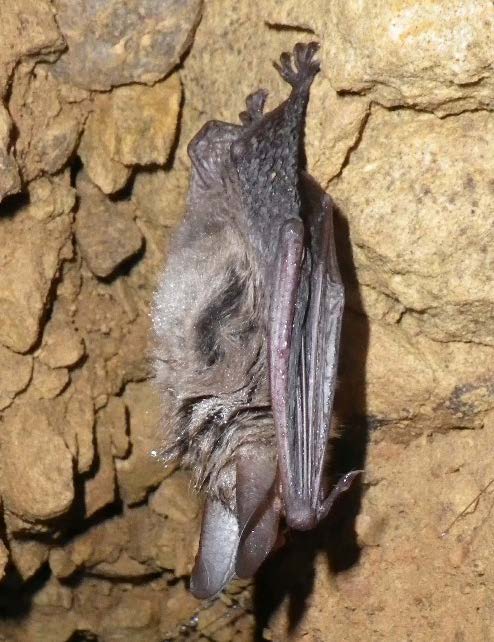
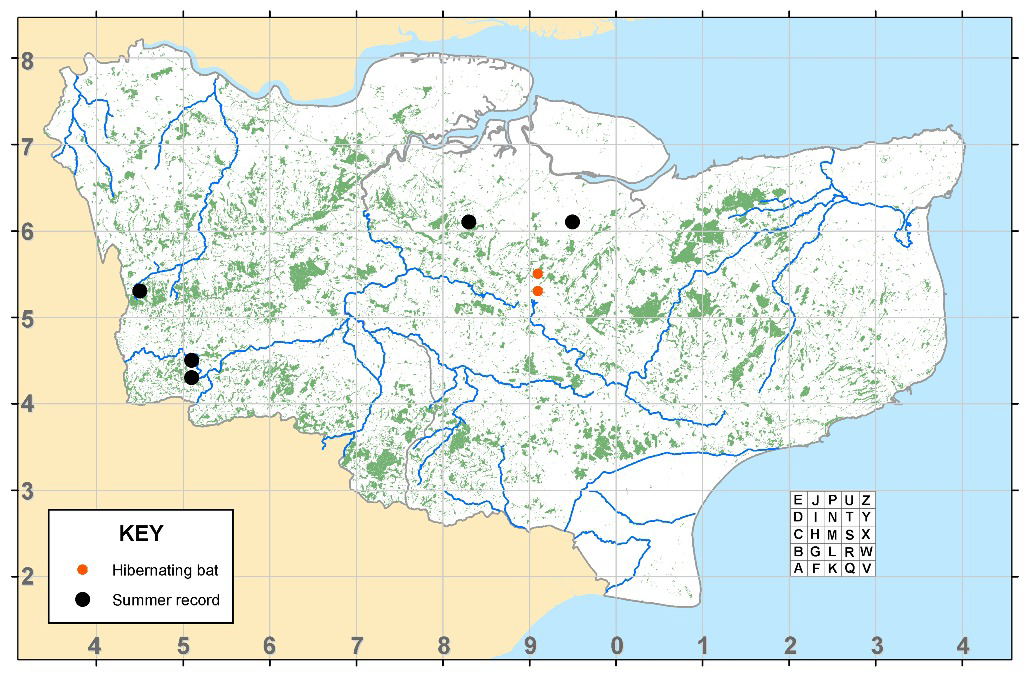
The first record in Kent was of an individual hibernating in a denehole in east Kent in January 2001. In August 2008 a single male was captured in a harp trap at a nearby swarming site. In July 2009, during the BCT Bechstein’s Bat Survey, a lactating female was recorded in west Kent, thus confirming its status as a breeding species in the county. This find was followed up in August 2012 when another female was trapped at the same site and radio-tracked. On subsequent nights the bats were found to be using three trees, and a cumulative count confirmed the presence of a colony of at least 33 bats. More recent records from the VWT suggest presence is still confirmed in Kent.
