
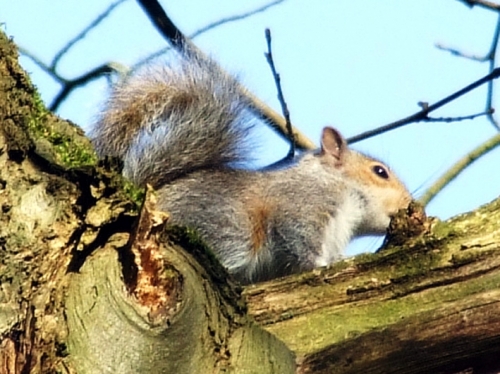

Habits
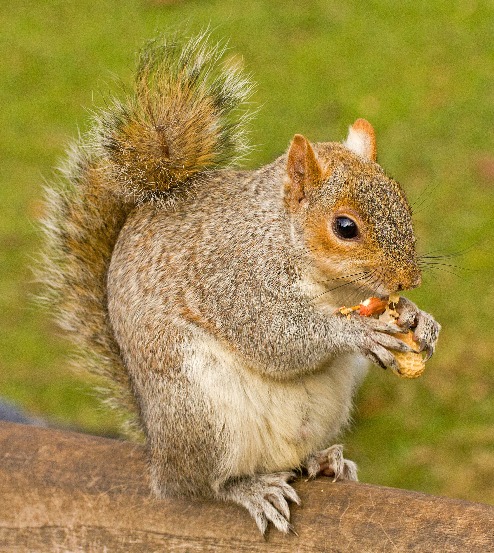
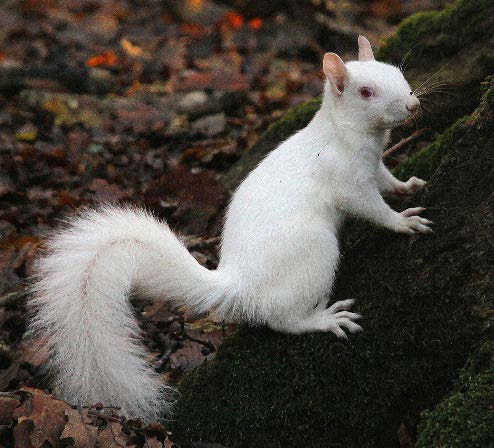
The grey squirrel prefers mature broad-leaved woodlands with a rich understorey of vegetation and can also be found in smaller numbers in conifer woodlands. However, this species has adapted well to the urban environment and is seen in parks and gardens containing mature trees. It is also encountered in the towns and villages throughout Kent.
Regular visitors to bird tables, grey squirrels feed on a variety of seasonal food including tree seeds, nuts, buds and sap as well as insects, fungi and on occasion bird eggs and nestlings. Cannibalism has also been noted at times.
During the autumn they can regularly be seen burying seeds and nuts in small scrapes in the ground, scatter caching the food for times when it is hard to come by. Retrieval of this buried food is by a combination of memory and smell. Grey squirrels do not hibernate, but may remain in their dreys or dens (see below) during very harsh weather.
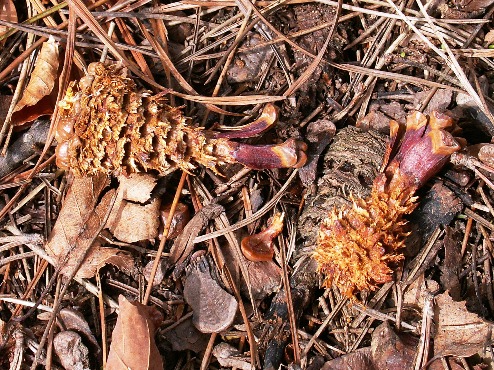
Field signs
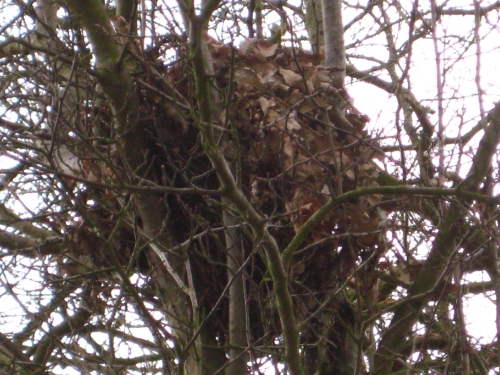
Grey squirrels are active during the day and sleep at night in two main types of nest:
- dreys, domed nests found in the forks of trees
- dens, hidden away in tree hollows
During winter the dreys are a much more substantial structure designed to keep out the cold.
Reproduction and life cycle
Breeding can take place up to twice a year, generally December to February and May to June with gestation lasting for 44 days after mating. On average three young but sometimes as many as seven are born and take up to 10 weeks to wean.
Males take no part in rearing the young and the females nest alone with the developing young during this period. Sexual maturity is generally reached at 12 to 14 months for females and slightly less for males.
The average lifespan is three to four years, but some have been known to live for up to nine years in the wild and 20 in captivity.
Distribution, status and conservation
A non-native species, the grey squirrel was introduced at Benenden between 1892 and 1902 and at Sandling in 1910 (Shorten, 1954); most of Kent was occupied by 1930, apart from the east of the county and the islands of Grain and Sheppey. By 1935 these island pockets were colonised (Parsons and Middleton, 1937). By 1945 only Thanet remained uncolonised and this remained the case up to 1952 (Shorten, 1954).
In contrast the native red squirrel was considered very common in 1908, but was confined to the eastern half of Kent and along the county’s western border by 1945. By 1959 it was only recorded in four parishes, subsequently becoming extinct within the county.
